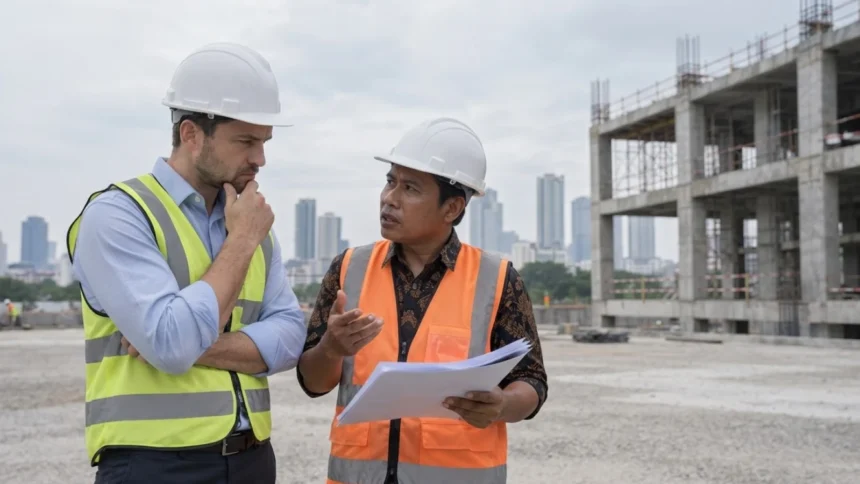
Construction projects in Indonesia often involve complex contracts and potential disputes between project owners and contractors. As Indonesia’s construction regulator notes, “one of the main problems” in the industry is exactly such “construction disputes between the project owner (service user) and the contractor”.
Foreign investors should be aware that Indonesian law requires licensed contractors and written agreements. The new Construction Services Law (Law No. 2 of 2017) governs building projects. It replaces the old 1999 law and effectively enforces the Civil Code’s rules on “work contracts” (perjanjian pemborongan). Under Law 2/2017, contractors must meet legal standards (e.g. hold a valid Badan Usaha Jasa Konstruksi license) and carry out contracts responsibly.
The law even introduced Dispute Boards (Dewan Sengketa): a panel formed during the project to resolve claims before they become full disputes. In fact, officials praise the law for giving “legal certainty in the construction services sector”. However, some investment restrictions remain. As Indonesia’s Public Works Minister noted, Law 2/2017 still contains clauses that can “hinder foreign investors”, for example requiring foreign toll-road investors to partner with a local firm.
Given this backdrop, foreign investors should plan ahead. A clear, well-drafted contract is the first key. Include a detailed scope, payment schedule, quality standards, and change-order procedures. Key clauses should cover dispute resolution: for example, specify arbitration (with seat and rules) or court jurisdiction. Use active, simple language like avoid vague terms. Keep records of all communications, designs, approvals, and payments.
Dispute Resolution Options
If a dispute arises, Indonesian law offers several paths. The main options are:
- Negotiation and Mediation
Parties can negotiate directly or use mediation to reach a settlement. This is informal but often saves time. Indonesian parties often try mediation first.


- Dispute Board (Dewan Sengketa)
Under Law 2/2017, a Dispute Board can be formed right in the contract. Its role is to “straighten out all claims” from either party “before they develop into disputes”. The Board meets regularly to prevent misunderstandings. If used, it can resolve issues in real time and preserve the relationship. The Construction Director General explained that disputes “often are settled through litigation handled by non-expert judges, resulting in unfair decisions”, so on-site dispute boards are seen as a better way.
- Arbitration
This is the most common formal route. Indonesia’s Arbitration Law (Law No. 30 of 1999) explicitly promotes arbitration and other alternatives, aiming for a system “faster, more efficient, and more flexible than litigation”. Many Indonesian contracts name BANI (the Indonesian National Arbitration Board), ICC, or other arbitral institutions. Arbitration awards are final and binding on the parties.
Indonesia has ratified the New York Convention, so foreign arbitral awards can be enforced in Indonesia as domestic judgments. Note, however, that even BANI awards can be challenged in court under very limited grounds. One recent study points out that BANI’s decisions, while final, “can be submitted for cancellation to the District Court on fraud grounds” under Article 70 of Law 30/1999. In practice, courts have annulled some awards when fraud or serious irregularities were proven.
- Litigation (Courts)
If arbitration is not chosen or fails, a party can file a civil lawsuit in an Indonesian court. This starts at the District Court, and can go through appeals up to the Supreme Court. Cases are heard by judges, which can make outcomes uncertain. Courts may uphold or rewrite contracts and can order damages.
Courts can also annul arbitral awards in narrow cases. For example, Jakarta’s South District Court once handled a suit by the government to cancel a construction arbitration award. It held that the annulment petition met legal requirements. In that case, a joint venture between SMCC and Hutama was the contractor for a highways project. The public works agency successfully moved to vacate the arbitral award.
- Investor-State Arbitration (ICSID)
In very large projects involving state guarantees, foreign investors might have access to investor–state arbitration under international treaties. Indonesia is a contracting state to the ICSID Convention (via Law No. 5 of 1968). Under this, ICSID awards are “final and binding” on Indonesia, and domestic courts cannot review them. However, this route applies only if the project is covered by an investment agreement (e.g. a bilateral investment treaty or presidential decree).
Key Steps for Foreign Investors
Given these options, foreign investors should take proactive steps before and during construction to protect their interests:
- Hire experienced local counsel. Engage lawyers familiar with construction law, contracts, and Indonesian courts. They can help draft contracts and advise on licenses, taxes, and permits.
- Vet your contractor. Work only with licensed contractors (BUJK holders) and check their track record. Investigate any risk of corruption or financial trouble.
- Negotiate robust dispute clauses. Include clear terms on governing law, arbitration (or other ADR), and jurisdiction. A common strategy is to use Singapore law and seat arbitration in a neutral venue, or ICSID arbitration if available. Ensure the clause covers all likely issues (e.g. payment disputes, delays, defects).
- Use a Dispute Board. For large projects, consider contractually establishing a Dewan Sengketa. This is expressly supported by Indonesian law as a way to handle claims early. A board of independent experts can issue non-binding recommendations to keep the project on track.
- Maintain documentation. Keep meticulous records include plans, change orders, meeting minutes, payment receipts, quality tests, communications (emails or letters). This evidence will be crucial if disagreements reach arbitration or court.
- Pursue amicable resolution first. If a conflict starts, try to solve it through negotiation or mediation. This can preserve business relationships and avoid costly trials. Indonesia’s courts also encourage mediation even after a lawsuit is filed.
- Be ready to enforce the contract. If negotiation fails and arbitration is chosen, prepare a strong case with technical and legal experts. Remember that Indonesian courts will enforce arbitral awards (domestic or foreign) unless very narrow invalidation grounds apply. If litigation proceeds, understand the timeline: Indonesian civil cases typically take one to two years at first instance, longer if appealed.
- Consult experts and use technology. Learn from experts in construction law. As one commentator noted, Indonesian judges often lack engineering backgrounds, so having expert witnesses is critical. Use legal-tech platforms (like Legal Hero) to access up-to-date regulations and cases efficiently, as suggested by recent legal articles.
State vs. SMCC–Hutama Case
One recent example highlights these issues. In Direktorat Jenderal Bina Marga v. SMCC–Hutama Joint Operation (2015), the Indonesian highways agency (a state contractor) challenged an arbitration award in South Jakarta District Court. The project involved a major road contract with a Chinese–Indonesian joint venture.
When disagreements arose, an arbitral tribunal had decided in favor of the joint venture. The government then sued to annul that award, invoking Law No. 30/1999 on arbitration. The District Court ultimately accepted the annulment request as legally valid. This case shows that Indonesian courts will closely scrutinize arbitration results. If fraud or procedural defects are proven, even a binding arbitration can be overturned.
Protect Your Construction Project with Hukumku
Construction disputes can quickly turn into costly delays, payment conflicts, contract claims, or even litigation and arbitration. For foreign investors, navigating Indonesian construction law and dispute resolution can be even more challenging.
Hukumku helps businesses and foreign investors navigate legal risks in Indonesia, from reviewing construction contracts and identifying potential risks to supporting dispute resolution when conflicts arise.
Whether you are preparing a construction agreement, dealing with a contractor dispute, or considering arbitration or litigation, getting legal advice early can help you protect your investment and make informed decisions.