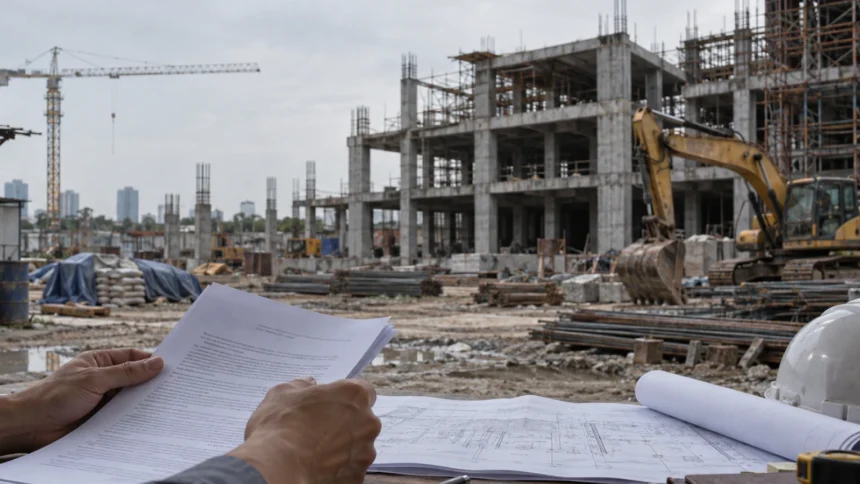
Imagine you’ve hired a contractor in Indonesia to build your home or office. After paying an advance and seeing initial progress, the work suddenly stops. The contractor has vanished and the construction is left unfinished. You ask: can I sue? Indonesian law says yes.
All contracts in Indonesia (including construction contracts) are legally binding. The owner can sue a contractor who fails to finish the agreed work.
Legal Basis: Contracts and Obligations
Under the Civil Code (KUHPerdata), contracts must be honored. Article 1239 states that any unmet obligation must be compensated. Article 1243 says that if one party defaults, the other party may demand performance or cancel and claim losses. Simply put, if the contractor breaches the contract by stopping work, the owner can sue for breach of contract.
Construction law also applies. Law No. 2 of 2017 on Construction Services requires contractors to fulfill safety and quality obligations. While this law focuses on technical standards, for example, fixing structural defects, its principle reinforces contractual duties. An Indonesian court will view a contractor’s unjustified halt as a clear breach of both the contract and construction regulations.
Contractor’s Failure to Perform
If the contractor stops work, first check the contract’s dispute-resolution clause. Many construction agreements include an arbitration clause. If so, you must follow that agreed arbitration procedure under Indonesia’s Arbitration Act (UU No. 30/1999) before suing in court.
If there is no arbitration clause, or after arbitration is exhausted, you can file a lawsuit at the Pengadilan Negeri (District Court) where the contractor is based. Indonesian law requires you to send a formal warning letter (somasi) before filing a claim In fact, the Supreme Court has held that a case may be dismissed if no warning was given beforehand.



After sending notice, you can proceed to court. The owner must prove the contract exists and that the contractor did not perform. Evidence may include the signed contract, payment receipts, photographs of the unfinished site, work logs, and any correspondence. Witness testimony or expert appraisals also help.
Legal Remedies: Suing for Breach
In court, the owner usually demands cancellation of the contract and money damages. Article 1243 of the Civil Code allows the creditor to choose specific performance or cancellation with compensation. In practice, courts often cancel the contract and award damages.
Damages cover the cost to hire a new contractor to finish the project, plus related losses, such as extra labor costs, rent or financing costs due to delay. The court may also award interest and legal costs. Article 1267 explicitly allows the non-breaching party to claim contract cancellation with “costs, losses and interest”. This means the contractor may have to pay the difference in completion cost as well as any default interest or collection expenses. The owner should present a clear calculation, for example, getting an independent estimate for finishing the work and documenting any extra expenses caused by delay.
Before trial, the owner can ask the court for provisional measures. Indonesian courts can issue an attachment = order on the contractor’s assets to secure any future judgment. However, such measures usually wait until the lawsuit is filed and a hearing is set.
A recent Supreme Court case highlights these rules. In MA No. 672K/Pdt/2020, an Indonesian local government terminated a bridge construction contract without cause. The Court ruled the termination invalid. It treated the government’s act not as a criminal misconduct but as a contractual breach (wanprestasi).
The ruling held that the contractor should have been allowed to complete the work or be compensated for losses. In other words, the unilateral cancellation was void, and the government (as the owner) had to pay for the breach. This case shows even a powerful party cannot ignore a construction contract without remedy.
Conclusion
If your Indonesian contractor stops work without justification, you generally can sue. Indonesian law empowers the owner to file a breach-of-contract claim and recover losses. The owner should send a formal warning letter, document the unpaid work, and file suit in the local district court. With a valid contract and evidence of the breach, the court can order the contractor to either complete the job or compensate you for extra costs, interest and damages. Legal provisions (Civil Code Articles 1239, 1243, 1267) and court precedent all support the owner’s right to be made whole.